{
“@type”: “Article”,
“author”: {
“url”: “https://pestico.biz”,
“name”: “Pestico”,
“@type”: “Organization”
},
“@context”: “https://schema.org”,
“headline”: “Understanding Pest Control Terms: A Homeowner’s Guide 2025”,
“publisher”: {
“url”: “https://pestico.biz”,
“name”: “Pestico”,
“@type”: “Organization”
},
“inLanguage”: “en”,
“articleBody”: “Master understanding pest control terms with this simple guide for Texas homeowners and businesses. Learn key phrases and how they impact your property.”,
“description”: “Master understanding pest control terms with this simple guide for Texas homeowners and businesses. Learn key phrases and how they impact your property.”,
“datePublished”: “2025-07-31T01:27:10.641Z”,
“mainEntityOfPage”: {
“@id”: “https://pestico.biz/understanding-pest-control-terms-guide-2025”,
“@type”: “WebPage”
}
}
Pest control might sound straightforward, but the words professionals use can make your head spin. One misstep here can lead to misunderstanding or even costly mistakes—especially since most homeowners can save up to 30 percent on pest control bills just by knowing the correct terms. Most people assume pest lingo does not matter unless you work in the industry, but knowing a handful of key phrases might be the difference between an ongoing headache and a pest free home.
| Takeaway | Explanation |
|---|---|
| Understanding terms is empowering | It helps homeowners make informed pest control decisions and communicate effectively with professionals. |
| Accurate pest identification is essential | Knowing key identification terms enables better assessment and targeted pest management strategies. |
| Choose appropriate treatment methods | Understanding treatment terms helps match strategies to specific pests to maximize effectiveness. |
| Prepare for consultations with experts | Gather specific information about your pest issue to facilitate effective communication with pest control professionals. |
| Ask informed questions | Engaging with pest control experts using specific queries enhances understanding and treatment outcomes. |
Understanding pest control terminology is more than just learning industry jargon. It’s a critical skill that empowers homeowners to protect their property, make informed decisions, and effectively communicate with pest management professionals. By mastering key pest control terms, you gain the ability to tackle pest challenges strategically and proactively.
Pest control is a specialized field with specific terminology that can seem complex to the average homeowner. Learn more about pest management strategies that can help you understand these technical terms. According to the U.S. Environmental Protection Agency, knowing the right terminology is crucial for implementing Integrated Pest Management (IPM) effectively. IPM is a comprehensive approach that focuses on long-term pest prevention through a combination of techniques.
For instance, understanding terms like “infestation,” “vector,” and “threshold level” can help you better assess the severity of a pest problem. These terms aren’t just technical words they’re tools that allow you to communicate precisely about the challenges you’re facing. When you can describe a pest issue accurately, pest control professionals can develop more targeted and efficient solutions.
The University of California’s Statewide Integrated Pest Management Program emphasizes that accurate pest identification is the first step in effective pest management. Knowing the difference between terms like “pesticide” and “insecticide,” or understanding what “biological control” means, can help you make more environmentally responsible choices.
Moreover, some pest control terms directly relate to your health and safety. Terms like “residual treatment,” “spot treatment,” and “exclusion methods” are not just technical phrases they represent different approaches to protecting your living space from potential health risks. For example, understanding “vector” means recognizing which pests can transmit diseases, allowing you to take more proactive prevention measures.
Accurate terminology translates directly into cost-effective pest management. The University of Florida’s Institute of Food and Agricultural Sciences advises that pest control should be considered part of routine home maintenance. By understanding terms like “monitoring,” “prevention,” and “treatment threshold,” you can develop a more strategic approach to pest control.
Knowing these terms helps you:
Ultimately, understanding pest control terms is about empowerment. It transforms you from a passive homeowner to an active participant in protecting your property. By investing time in learning this terminology, you’re not just acquiring knowledge you’re developing a proactive approach to home maintenance and pest prevention.
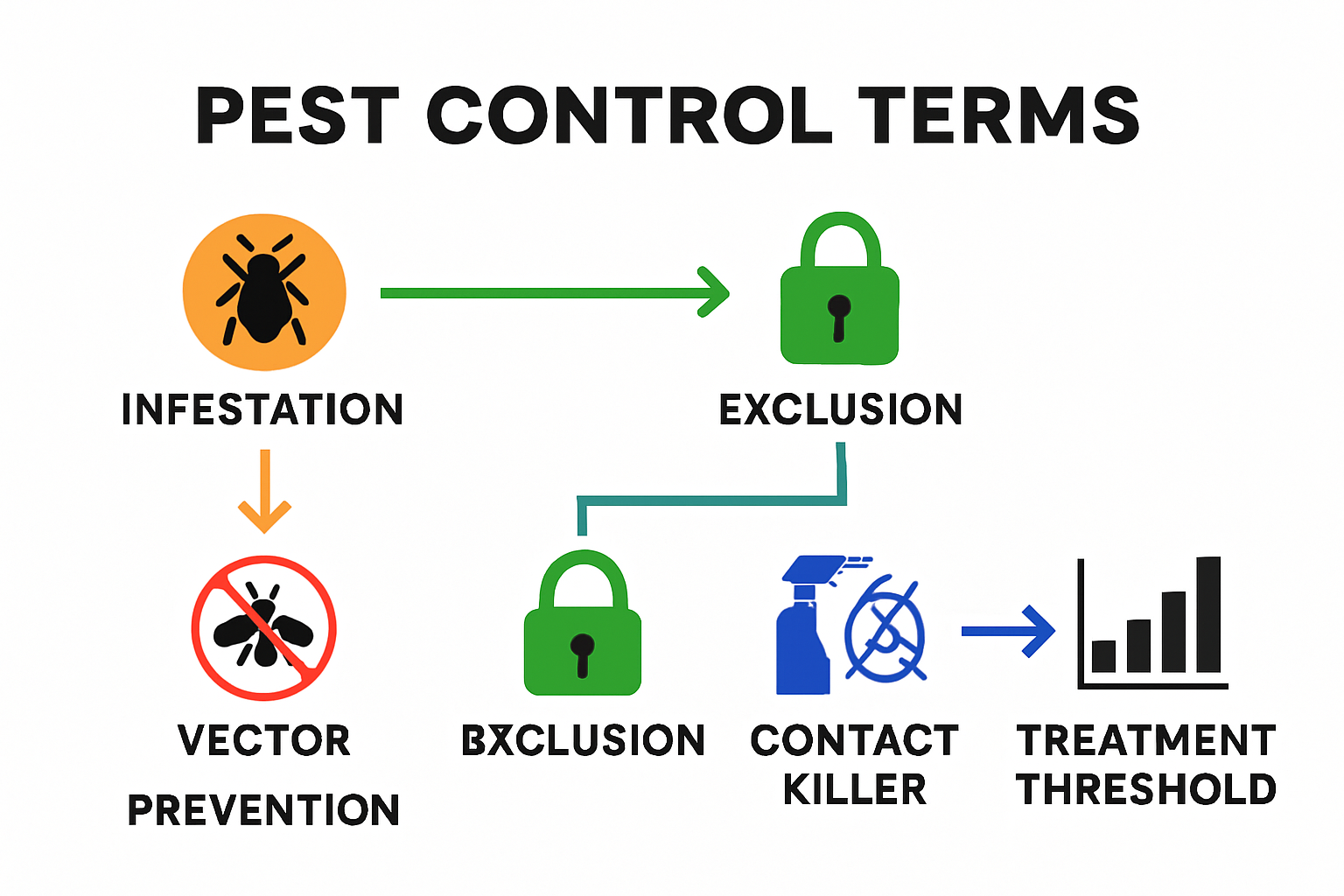
Navigating the world of pest control requires understanding a variety of specialized terms that professionals use to describe pest behaviors, treatment methods, and prevention strategies. Explore the fundamentals of pest management to better comprehend these essential concepts and protect your home effectively.
Accurate pest identification is the cornerstone of effective pest management. According to the National Pest Management Association, several key terms help homeowners and professionals understand pest characteristics:
Understanding these terms allows homeowners to communicate more precisely about pest problems. When you can describe the extent and nature of a pest issue, pest control professionals can develop more targeted treatment strategies.
To help clarify essential pest identification language, here is a table summarizing fundamental pest identification terms mentioned in this section:
| Term | Definition | Example |
|---|---|---|
| Infestation | Presence of a large number of pests in an area, causing damage or health risks | Termite infestation in walls |
| Vector | Organism that transmits diseases or parasites between hosts | Mosquito transmitting West Nile virus |
| Species | Specific type of pest with unique characteristics | German cockroach, Argentine ant |
The Environmental Protection Agency emphasizes the importance of understanding treatment approaches. Key terms in this category include:
These terms represent different strategies for managing pest populations. Biological control, for instance, offers an environmentally friendly alternative to traditional chemical treatments, targeting specific pest species while minimizing broader ecosystem impacts.
Professionals use specific terminology to describe chemical treatments and application methods. The University of California Agriculture and Natural Resources provides insights into these technical terms:
Knowing these terms helps homeowners understand the nuances of pest control treatments. For example, a residual treatment offers longer-lasting protection compared to a contact killer, which provides immediate but temporary relief.
By familiarizing yourself with these pest control terms, you become a more informed homeowner. This knowledge empowers you to make better decisions about pest management, communicate effectively with professionals, and develop more proactive strategies for protecting your home from unwanted invaders.
Understanding pest control terminology is not just about learning new words it’s about making informed decisions that protect your home and health. The language of pest management directly influences the treatment strategies you choose and how effectively you address pest challenges.
Every pest problem requires a unique approach. According to the Centers for Disease Control and Prevention, understanding specific pest terms helps homeowners select the most appropriate treatment method. Different pests require different strategies based on their biology, behavior, and potential risks.
For instance, knowing the difference between “sporadic” and “continuous” pests can significantly impact your treatment approach. Sporadic pests appear occasionally and are typically easier to control, while continuous pests require ongoing management strategies. Some key considerations include:
The Environmental Protection Agency’s Integrated Pest Management guidelines emphasize that terminology directly influences treatment selection. Professional pest control involves more than just applying chemicals. Learn about comprehensive pest management approaches that consider multiple factors.
Chemical treatment terms provide crucial insights:
Non chemical terms are equally important:
Below is a comparison table summarizing chemical and non-chemical treatment options mentioned, highlighting features and effectiveness:
| Treatment Option | Type | Description | Protection Duration |
|---|---|---|---|
| Residual Treatment | Chemical | Chemicals remain effective after application | Long-term |
| Contact Killer | Chemical | Kills on direct contact, immediate but temporary effect | Immediate, short-term |
| Systemic Treatment | Chemical | Absorbed by plants/structures for future protection | Extended (varies) |
| Exclusion Methods | Non-Chemical | Prevent pests by sealing entry points | As long as maintained |
| Biological Control | Non-Chemical | Use of natural predators or parasites | Ongoing (natural balance) |
| Mechanical Control | Non-Chemical | Physical removal via traps/barriers | Immediate/ongoing |
The National Pest Management Association highlights that precise terminology helps homeowners understand treatment limitations and expectations. Key effectiveness terms include:
Knowing these terms helps you:
By mastering pest control terminology, you transform from a passive observer to an active participant in protecting your home. Each term represents a strategic tool that empowers you to make smarter, more informed pest management choices. The right language doesn’t just describe the problem it helps you solve it.
Effective communication with pest control professionals is crucial for resolving pest issues efficiently and accurately. Understanding how to articulate your pest problems using precise terminology can dramatically improve the quality of service you receive and help experts develop targeted solutions for your specific situation.
Before meeting with a pest control professional, gathering specific information about your pest problem is essential. The National Pest Management Association recommends documenting key details that will help experts diagnose and address your issue more effectively. Discover comprehensive pest management strategies to enhance your preparation.
When preparing for your consultation, focus on collecting these critical pieces of information:
By presenting this information systematically, you help pest control experts quickly understand the scope and nature of your pest challenge. The more precise your description, the more targeted their initial assessment can be.
According to the University of California Agriculture and Natural Resources, using correct pest control terminology demonstrates your understanding and helps professionals take you seriously. Avoid vague descriptions and instead use specific terms that accurately describe your observations.
Key phrases and terms to incorporate include:
For example, instead of saying “I have some bugs,” you might say “I’m experiencing a continuous ant infestation primarily in the kitchen, with multiple entry points near the baseboards.”

The Environmental Protection Agency’s Integrated Pest Management guidelines emphasize the importance of asking informed questions. A strategic approach helps you understand the proposed treatment and its potential implications.
Consider asking these professional questions:
These questions demonstrate your commitment to understanding the pest management process and show the professional that you are an engaged, informed client.
Remember, clear communication is a two way street. While using proper terminology is important, also remain open to the expert’s explanations and recommendations. Pest control professionals bring years of experience and specialized knowledge that can provide insights beyond technical terms.
By approaching your pest control consultation with preparation, precise language, and thoughtful questions, you increase the likelihood of receiving an effective, efficient solution to your pest challenges. Your proactive communication transforms the interaction from a simple service call to a collaborative problem solving experience.
Understanding pest control terms is crucial for homeowners as it empowers them to make informed decisions, communicate effectively with pest management professionals, and implement more cost-effective pest control strategies.
An infestation refers to a large number of pests that have established themselves in a specific area, potentially causing damage. A vector is an organism, often a pest, that can transmit diseases or parasites from one host to another.
Key pest control treatment methods include Integrated Pest Management (IPM), exclusion methods to block entry points, biological control using natural predators, and chemical treatments like residual or spot treatments.
To prepare for a consultation, gather specific information about the pest issue, including pest identification, location of infestation, duration of the problem, and any observed behaviors. This information helps professionals assess the situation more accurately.
Have you ever felt confused by pest control jargon or worried you might choose the wrong treatment for your home? This guide has shown how the right terminology can keep your family safe and help you save money. The real challenge comes when it is time to act. Even a small misunderstanding about words like infestation or residual treatment could lead to unneeded stress and wasted money. That is why families all across our area rely on trusted experts who understand both the language and the science of pest control.

You do not have to fight pests alone or risk miscommunication. Instead, let the specialists at Pestico take the guesswork out of protecting your home. We offer affordable, family-focused services for all your pest, termite, mosquito, and rodent needs. If you are looking for fast answers or want to see how our team solves pest problems the right way, contact us at Pestico today. Put your new knowledge into action and get a custom, jargon-free solution built for your peace of mind. Time to reclaim your comfort and confidence at home.